The Periods of English Literature
The history of English literature is very closely related to the history of the English people. It began with the emergence of the English nation and continued evolving along with its social development. Each of the phases, known as Age or Period. It has been given a particular name, sometimes after the name of the king or queen, sometimes after the name of a great writer, and sometimes according to the spirit of the time. The names and time span of the ages of English literature differ from historian to historian; the following list derived from M. H. Abrams is dependable:The Old English Period or The Anglo-Saxon Period (450-1066)
The Middle English Period (1066-1500)
- a) The Anglo-Norman Period (1066-1340)
- b) The Age of Chaucer (1340-1400)
The Renaissance Period (1500-1660)
- a) Elizabethan Age (1558-1603)
- b) Jacobean Age (1603-1625)
- c) Caroline Age (1625-1649)
- d) Commonwealth Period (1649-1660)
The Neoclassical Period (1660-1785)
- a) The Restoration Period (1660-1700)
- b) The Augustan Age or The Age of Pope (1700-1745)
- c) The Age of Sensibility or The Age of Johnson (1745-1785)
The Romantic Period (1798-1832)
The Victorian Period (1832-1901)
- a) The Pre-Raphaelites (1848-1860)
- b) Aestheticism and Decadence (1880-1901)
The Modern Period (1901-1939)
- a) The Edwardian Period (1901-1910)
- b) The Georgian Period (1910-1936)
The Post-modern Period (1939 – Present)
Dominating Genres in Different Periods
You must remember the following diagram because these branches will be taught to you in the next years. It will help you to explore literary knowledge in many ways.
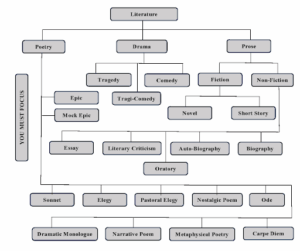
Dominating Genre in Different Periods
- Old English Period: Epic poem
- Middle English Period: Poetry
- Renaissance Period: Drama, Poetry, Essay
- New-classical Period: Drama, Novel, Poetry (All are based on Satire), Non-Fictional Prose especially Essay/Literary Criticism
- Romantic Period: Poetry, Non-Fiction, Novel
- Victorian Period: Novel, Poetry, Drama, Non-Fiction
- Modern Period: Novel, Poetry, Drama, Short Story, Non-Fiction
- Post-Modern Period: All
Striking Name and Object of the Periods
Old English Period
| Beowulf | Anglo-Saxon Chronicles | German Tribes | Anonymous Writing |
Middle English Period
| Norman Conquest | Chaucer | The Canterbury Tales | Hundred Years War | Black Death |
Renaissance Period
| Renaissance | Comedy | Tragedy | Tragicomedy |
| Comedy of Humor | Beast Fable | William Shakespeare | Christopher Marlowe |
| Ben Johnson | Edmund Spencer | Francis Bacon | John Webster |
| Humanism | |||
Neo-classical Period
| Comedy of Manners / Restoration Drama | Age of Prose and Reason | Dr. Samuel Johnson |
| Satirical Writing | Literary Criticism | Addison and Steele |
| Epic | Mock Heroic Poem | Alexander Pope |
| Jonathan Swift | Dictionary | Aphra Ben |
| Daniel Defoe | Novel | John Milton |
Romantic Period
| French Revolution | Lyrical Ballads | Escapism |
| Imagination | Supernaturalism | Fancy |
| Pantheism | The Romantics | Romantic Movement |
| Biographia Literaria | Negative Capability | Pastoral Elegy |
Victorian Period
| Victorian Compromise | The Bronte Sisters | Pre-Raphaelitism | Adventure |
| Dramatic Monologue | The Origin of Species | Oxford Movement | Tennyson |
| Mathew Arnold | Robert Browning | G.M. Hopkins | Charles Dickens |
Modern Period and Post-Modern Period
| Stream of Consciousness | One-Act Play | Drama of Ideas | Absurd Drama |
| Modernism | Modern Trends of Poetry | World War I & II | W. B. Yeats |
| G. B. Shaw | J. M. Synge | Wole Soyinka | T. S. Eliot |
| Sylvia Plath | |||
